


Community Schools Building Authentic Hubs of Support Across L.A. County
Wed Feb 25 09:49:00 PST 2026
A new case study offers valuable insights for implementing the California Community Schools Partnership Program.
Since its launch, the Los Angeles County Office of Education’s Community Schools Initiative (LACOE CSI) has been at the forefront of reimagining education into schools that support whole-child success. Now, several years after its inception, a new WestEd case study highlights how LACOE CSI’s countywide community school support has led to effective school transformation.
In 2019, LACOE CSI launched one of the first county-operated community school models in the nation. Through partnerships with local educational agencies and state and county agencies, LACOE CSI worked with a select number of regional schools to pilot a community school model.
Since then, this work has expanded and is now led by LACOE CSI’s School-Based Implementation Unit, one of two units within the division dedicated to supporting L.A. County schools in implementing the California Community Schools Partnership Program (CCSPP). Today, the unit directly supports 23 school sites with LACOE staff serving as on-site practitioners of the community schools model, providing staffing support, technical assistance and fiscal and administrative oversight.
The report, “Bright Spots in Practice: Case Studies From the Los Angeles County Office of Education’s Community Schools Initiative,” explores three schools directly supported by LACOE CSI’s School-Based Implementation Unit. Each at different stages of implementation, these schools are highlighted as models of effective CCSPP implementation strategies shaped by the unique strengths, needs and contexts of their own communities.
Waite Middle School, Norwalk La Mirada Unified School District
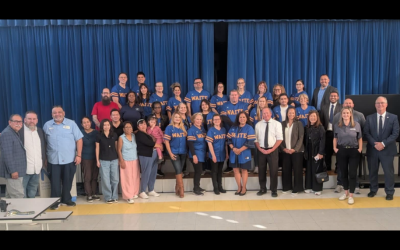
Waite Middle School serves as a shining example of how schools can foster a culture of respect and collaboration during their first year of CCSPP implementation. By actively listening to students and families, Waite has effectively translated feedback into engaging programs. From the start, Waite prioritized student voices by learning about their interests and launching popular clubs based on feedback, including an eSports and Pokémon club. With strong student interest, the school strategically connected club participation to academic and behavioral expectations, establishing a culture of belonging and accountability for student success. Waite also approached parent engagement with similar principles. By listening to feedback and making small changes, such as adjusting workshop times to better accommodate family schedules, the school demonstrated how simple steps can show respect for family voice and create momentum for deeper engagement.
Ganesha High School, Pomona Unified School District
Ganesha High School offers a powerful example of what is possible when a fully integrated community school team is seamlessly embedded into daily school operations. Ganesha has effectively built and sustained a cross-functional community school team that shares responsibility for student success and aligns CCSPP strategies across school and district operations. The promising practices highlighted in the case study offer invaluable lessons for other community schools on how this level of integration can strengthen collaborative leadership, reduce fragmentation and ensure that community school strategies are sustained beyond individual roles or funding cycles.
Littlerock High School, Antelope Valley Union High School District
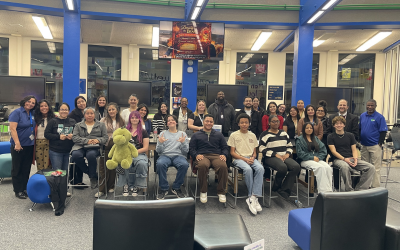
Despite long-standing challenges such as geographic isolation, limited economic opportunity and access to resources, Littlerock High School has become a trusted resource hub for its students, families and broader community. Centrally located within an underresourced region of L.A. County, the school leveraged its location to connect students and families with essential services. The case study explores how Littlerock created a culture of care that extends beyond the campus by becoming a hub for community connection and support. It offers inspiring insights for other schools that aim to strengthen their ties to their communities, demonstrating that resilience, creativity and dedication can lead to meaningful change.
Regardless of where a school stands in its community school journey, these case studies offer clear insights into the importance of intentional design when implementing the CCSPP framework and how county-level support can help elevate these efforts.
Alicia Garoupa, LACOE Chief of Wellbeing and Support Services, recently spoke with WestEd to discuss the community school transformation occurring across L.A. County and to share the core principles and cultural changes necessary to transform schools into hubs that support the whole child.
“The beauty of community schools is that local design and the reflection of community assets and voice are in everything that we do,” Garoupa shared. “The school is not transactional—it’s not that you come through the doors and then you leave and go home. We are actually interdependent and connected. We have to see each other that way in order to really change what we’re doing in public education.”
Visit WestEd.org to download the full report or read the full conversation with Alicia Garoupa.
SHARE


Tags
 Ganesha High School
 Littlerock High School
 Waite Middle School